
When Skill Loses to Software: How Cheating Is Poisoning Call of Duty Ranked Play
Posted in: Call of Duty · Gaming · Esports
Date: 2026-9-29 15:23:07
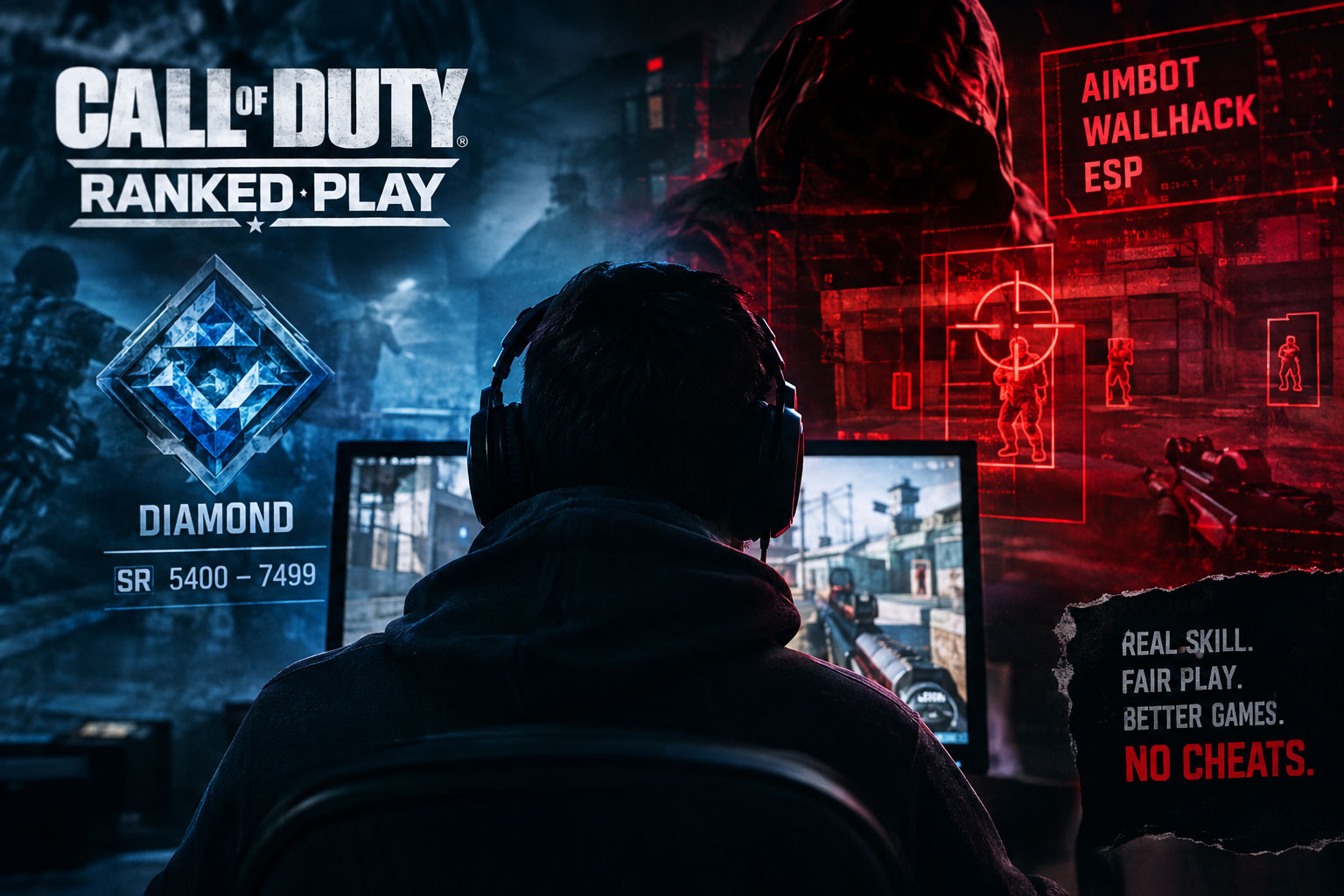
There is a particular kind of frustration that only competitive gaming can produce: spending years developing the reflexes, map knowledge, positioning, movement and game sense necessary to compete at a high level, only to discover that the person on the other side of the screen may not be playing by the same rules.
That frustration has become a recurring subject in the Call of Duty community, particularly around Ranked Play.
For legitimate players, Ranked is supposed to answer a simple question: How good are you when everyone has to play fairly?
Cheating undermines that entire premise.
What Does It Mean to Cheat in Call of Duty?
For someone who doesn't play video games, the terminology can sound confusing.
An aimbot is software or hardware assistance that can automatically influence where a player's weapon aims. Depending on the cheat, the assistance can range from subtle corrections to extremely obvious targeting behavior.
A wallhack, sometimes called an ESP or similar cheat, gives a player information they normally shouldn't have—such as the location of opponents behind walls or other objects.
Imagine playing a game of basketball in which one player secretly receives a signal telling them where every opponent is standing and another system helps them aim every shot.
The problem isn't simply that they might win.
The problem is that everyone else is competing under different rules.
Call of Duty's own Code of Conduct defines the use of cheats and third-party software that provides an unfair advantage as unacceptable.
The Most Frustrating Scenario: Losing, Then Turning to Cheats
Among the complaints frequently raised by experienced players is a particularly ugly version of cheating: the player who appears to be competing normally until the match begins going badly.
Then something changes.
A player gets outplayed in a gunfight. They lose an engagement they expected to win. An opponent repeatedly predicts their movement, wins the next few fights or begins taking control of the match.
And instead of accepting the loss, the losing player may turn to unauthorized assistance.
This is sometimes described by the community as "rage cheating"—using cheats more aggressively once a player becomes frustrated or feels they are being outplayed.
It is important to distinguish an accusation from proof. A spectacular kill, strange pre-aim or seemingly impossible reaction is not automatically evidence of cheating. Highly skilled Call of Duty players can have extraordinary reaction times, positioning and game knowledge.
But documented cheating is not hypothetical. Activision continues to operate RICOCHET Anti-Cheat specifically to detect and disrupt unauthorized assistance, using client-side technology, server-side analysis, investigations and hardware-security measures.
Why Experienced Players Notice the Difference
The better a player becomes, the more they understand what information is legitimately available.
A strong player may appear to "know" where an opponent is because they understand spawn patterns, footsteps, minimap information, objective timing, common routes and previous engagements.
That's game sense.
A wallhack is something fundamentally different.
It can provide information the player could not legitimately possess.
That distinction matters because high-level competition is built around information. Players constantly make decisions based on incomplete knowledge:
- Is someone behind that wall?
- Did the opponent rotate?
- Is the enemy holding the angle?
- Did another player hear that movement?
- Is it safe to challenge?
- Where will the next engagement happen?
Those uncertainties are part of the game.
Remove them with unauthorized information and an enormous part of competitive skill disappears.
Ranked Play Makes the Problem Worse
Cheating is frustrating in any mode, but Ranked Play raises the stakes.
A casual match can be annoying. A player can leave, start another game or shrug off a bad result.
Ranked Play attaches consequences to the outcome.
Players invest time trying to climb through divisions. Their victories represent progress, while defeats can cost them rating or momentum. When a legitimate player loses because another participant is cheating, the damage isn't limited to that single gunfight.
It can affect the entire competitive progression system.
That's why cheating complaints become especially intense at higher skill levels. Community discussions frequently include reports of suspicious behavior in higher Ranked divisions, although individual reports should not be treated as statistical measurements of the actual cheating rate.
That distinction is important.
A player saying, "I saw a cheater in my last three games," is reporting an experience—not proving that a particular percentage of the player population cheats.
Nevertheless, the persistence of these complaints demonstrates the reputational problem competitive Call of Duty faces.
The Psychological Damage Goes Beyond Losing
One of the most destructive consequences may be what happens after the match.
Once players believe cheating is common, legitimate deaths can begin looking suspicious.
A talented player makes an incredible prediction? He's probably walling.
Someone snaps onto a target quickly? Aimbot.
Someone knows where an opponent is rotating? He's cheating.
This creates a vicious cycle.
Actual cheaters damage trust.
Then distrust makes legitimate high-level gameplay look suspicious.
And legitimate players begin questioning whether their victories—and defeats—were earned.
That is disastrous for a competitive ecosystem.
A ranked system depends on players believing that the competition is reasonably fair. If that confidence disappears, the visible rank becomes less meaningful because players can no longer be certain what produced the result.
The Anti-Cheat Arms Race
Activision is not ignoring the problem.
RICOCHET Anti-Cheat is a multi-layered system designed to identify, investigate and disrupt cheating. On PC, it includes a kernel-level driver that monitors software interacting with protected Call of Duty titles. The company has also expanded hardware-based protections and other security measures.
Activision has also reported large numbers of hardware bans as part of its efforts against cheating and has described the cheating market as an organized ecosystem involving cheat developers, resellers, illicit accounts and evasion tools.
That reveals another uncomfortable reality: this isn't simply a handful of players downloading a suspicious program.
There is an entire commercial ecosystem built around cheating.
Cheats can be sold through subscriptions. Accounts can be sold to replace banned accounts. Tools can be marketed to evade enforcement. Developers can modify their software when anti-cheat systems catch up.
It becomes a technological arms race.
And That's the Problem With "Just Get Better"
Telling legitimate players to simply improve misses the fundamental issue.
Players should lose.
That's competition.
A better player should sometimes destroy you. A professional should be able to make an ordinary player look completely lost. Someone with thousands of hours of experience should be capable of winning fights that seem impossible to a newcomer.
That's what skill looks like.
Getting beaten by someone genuinely better is not a failure of competitive gaming.
It is the reason competitive gaming exists.
The problem occurs when software replaces skill.
There is a huge difference between getting your ass handed to you by a player who has spent years mastering Call of Duty and getting your ass handed to you by somebody who decided that losing wasn't acceptable and reached for an aimbot or wallhack.
The first scenario gives you something to learn from.
The second gives you nothing.
What It Does to the Call of Duty Community
Cheating doesn't only hurt the person who gets killed.
- It affects teammates who lose a match they could have won.
- It affects opponents who lose Ranked progress.
- It affects players who stop trusting legitimate high-level competitors.
- It affects creators and competitive players whose gameplay can be met with accusations simply because their skill looks extraordinary.
- It affects the reputation of the game itself.
Community discussions illustrate how intense the frustration can become. Players have described Ranked environments as increasingly difficult to trust at higher levels, while others push back against the tendency to label every exceptional player a cheater.
Both observations matter.
There are genuine cheaters.
There are also legitimate players who are exceptionally good.
The answer cannot be assuming that every unbelievable kill is evidence of cheating. Nor can it be dismissing every legitimate complaint as someone being angry about losing.
The responsibility falls on the competitive ecosystem to make that distinction as accurately as possible.
The Standard Should Be Simple
Competitive gaming doesn't require everyone to be equally talented.
It requires everyone to compete under the same fundamental rules.
A player should be able to lose a gunfight because the opponent had better aim.
They should be able to lose because the opponent had better positioning.
They should be able to lose because the opponent understood the map better.
They should even be able to get completely outplayed.
What should not determine the outcome is whether somebody secretly brought software or hardware assistance into a competition where everyone else agreed to play without it.
That is why the cheating issue matters beyond one angry player, one suspicious kill or one lost Ranked match.
The real currency of Ranked Play isn't SR. It's trust.
Players need to believe that when they climb, they earned it—and when they lose, they were actually beaten.
Without that confidence, the rank stops being a measurement of competitive skill and starts becoming a question mark.
And for a game built around competition, that may be the most damaging loss of all.