

Exploration of Biblical Narratives on Sodom and Gomorrah, Nephilim Giants, and Related Historical Accounts of Giants in the Americas
Posted in: Biblical Studies · Ancient History · Mythology Conspiracy
Date: 2026-8-18 06:58:18
WARNING: This article presents speculative interpretations of biblical texts, ancient legends, and historical explorer accounts about giants and Nephilim. It is not historical fact, scientific evidence, or instruction for any real-world action. Do not treat these stories as proof of hidden races, justification for conspiracy theories, or a basis for extreme beliefs, confrontations, or illegal behavior. Misusing this material can lead to poor decisions, wasted effort, or harm. Reader discretion advised
This report examines a series of interconnected claims drawn from biblical texts in the Old Testament (with limited New Testament references as specified in the source material), traditional interpretations, and historical accounts related to giants in the Americas. The content focuses on exploring the stated ideas, their scriptural foundations, associated interpretive traditions, and related historical or legendary narratives. No evaluation of factual accuracy is undertaken; instead, the material is presented as an exploration of the claims' content and supporting references.
The Narrative of Sodom and Gomorrah
The account of Sodom and Gomorrah appears primarily in Genesis 19 of the Old Testament. In this narrative, two visitors (identified as angels in the scripture) arrive in the city of Sodom in the evening. Abraham (the foundational patriarch of the Hebrews with whom God had established a covenant, and who had just interceded by pleading to God that the cities of Sodom and Gomorrah be spared, even if only a small number of righteous people could be found there) had a nephew named Lot. Lot lived in the city and was sitting at the city gate; upon seeing them, he rose to meet them, bowed with his face to the ground, and strongly urged them to seek refuge at his house rather than spend the night in the open square. He took them in, washed their feet, prepared a meal of unleavened bread for them, and they ate.
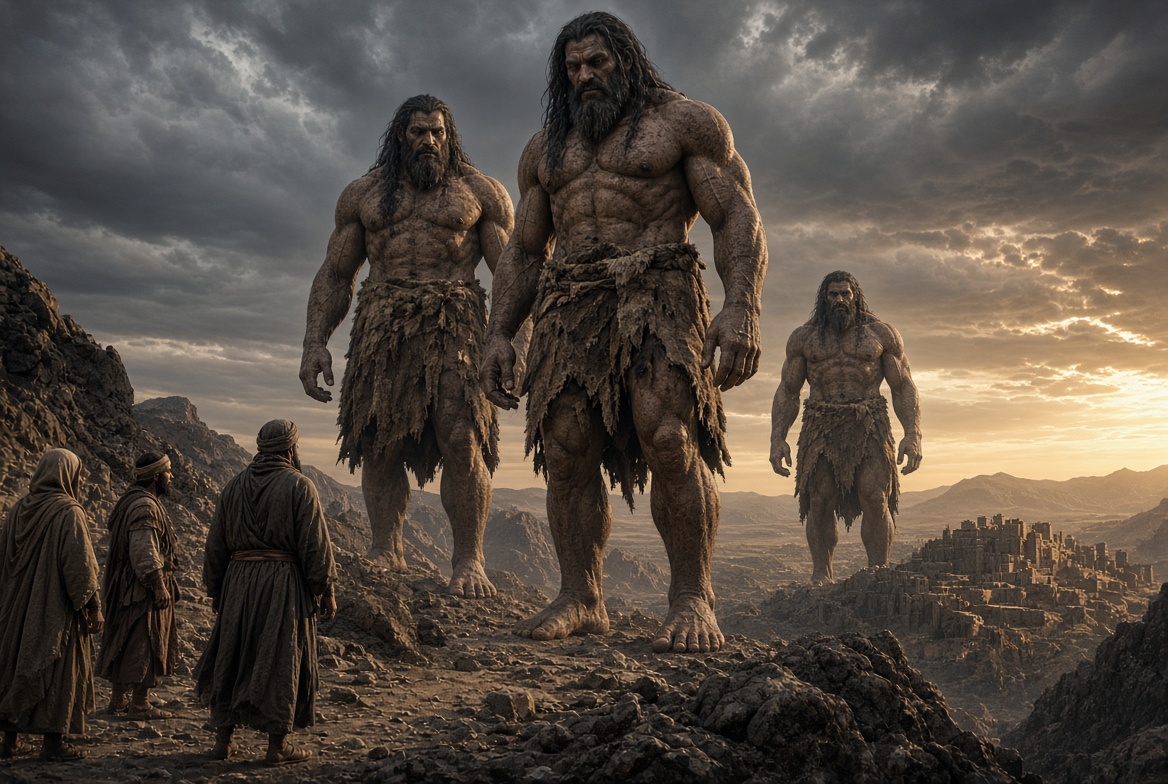
Afterward, the men of the city surrounded the house, demanding that the visitors be brought out so that they may "know" them, a term understood in context as seeking sexual relations. In Genesis 19:4 the text states that the men of Sodom, both greater and lesser of men (meaning giants and ordinary humans), surrounded Lot’s house. These men went after "strange flesh," and that "flesh" happened to be angels. They wanted to take advantage of the angels to produce even more Nephilim offspring. Which Nephilim are not fully flesh and are not fully spirit.
Lot went outside, closed the door behind him, and pleaded with the men not to act wickedly. He even offered his two virgin daughters to them instead, but the men of Sodom refused and threatened to do much worse to Lot than with his angelic visitors. They pressed hard against him and moved forward to break down the door. The angels reached out, pulled Lot back into the house, and shut the door. Then they struck the men outside—both great and small—with blindness so that they could not find the doorway.
The angels told Lot to gather any relatives he had in the city and leave, because they were about to destroy the place. Lot went out and spoke to his sons-in-law, who were pledged to marry his daughters, but they thought he was joking. At dawn the angels urged Lot to hurry, taking his wife and two daughters. When he hesitated, the angels grasped their hands and led them out of the city, instructing them to flee to the mountains and not look back. Lot asked to escape instead to a small nearby town called Zoar, and the request was granted.
As soon as Lot and his family reached safety, the Lord rained sulfur and fire out of the heavens upon Sodom and Gomorrah, scorching the cities, the entire plain, all the inhabitants, and everything that grew on the ground. Lot’s wife looked back and became a pillar of salt. This pursuit of the angels’ strange flesh is what set God off and caused Him to destroy the place. The common misconception is that God destroyed Sodom and Gomorrah because of homosexuality, but the text identifies the offense as going after strange flesh—not men-on-men or girl-on-girl sex.
Key Takeaways:
- The men of Sodom are described as greater and lesser men, meaning giants and ordinary humans.
- They demanded sexual access to the two angelic visitors.
- The strange flesh they pursued was the flesh of angels.
- Their intent was to produce additional Nephilim offspring.
- Nephilim are beings that are neither fully flesh nor fully spirit.
- The angels blinded the attackers, rescued Lot and his family, and God destroyed the cities with fire and sulfur.
Biblical Prohibitions on Homosexuality
- Leviticus 18:22 and Leviticus 20:13 explicitly forbid male homosexuality.
- Romans 1:26 is the first passage that forbids lesbianism.
Explanations of Lot’s Wife Becoming a Pillar of Salt
Here is a clear summary of the main things people say about Lot’s wife becoming a pillar of salt:
Traditional Religious Interpretations
- The most common view is that it was a direct punishment for disobedience. The angels had explicitly commanded the family not to look back while fleeing. She did, so she was turned into salt.
- Many see it as evidence that her heart was still attached to Sodom. Looking back showed she longed for the life, possessions, or people she was leaving behind, so she shared in the city’s judgment.
- In Jewish midrash, some rabbis explain the salt specifically as “measure for measure.” One popular story says she had earlier refused to give the angelic guests salt (or went around asking neighbors for salt, thereby alerting the city to the visitors’ presence). Because she sinned with salt, she was punished with salt.
- Another midrashic tradition says she looked back out of compassion for her married daughters who had stayed behind in the city, and upon seeing the Divine Presence (Shekhinah) descending in judgment, she was transformed.
Symbolic / Moral Readings
- Jesus himself later said, “Remember Lot’s wife” (Luke 17:32), using her as a warning against looking back or clinging to the old life when judgment or deliverance comes.
- Many Christian and Jewish teachers treat her as a standing memorial: a permanent reminder not to hesitate, not to long for what God is destroying, and not to turn back once you have begun to follow.
Natural / Etiological Explanations
- A very widespread view is that the story originated as an explanation for the striking salt formations that actually exist near the Dead Sea. Mount Sodom is a massive salt mountain, and one prominent salt pillar has long been pointed out by locals and travelers as “Lot’s wife.” Ancient writers (including Josephus) claimed they had seen the pillar.
- In this reading, the biblical account is an etiological tale—a story that accounts for a real geographical feature by linking it to a dramatic event.
Scientific or Naturalistic Suggestions
- Some propose that during the catastrophe (whether volcanic, seismic, or an airburst), Lot’s wife was overtaken by the falling sulfur, ash, and mineral-rich debris and was rapidly encrusted or preserved in a salt-like formation.
- A few more speculative chemical theories have been offered (for example, rapid internal calcification under extreme conditions), but these are not widely accepted.
In short, the range of explanations goes from a straightforward miraculous punishment for disobedience, through moral and symbolic lessons, all the way to the idea that the story grew up to explain an actual salt pillar that people could see by the Dead Sea.
Ancient Explorers, American Giants, and the Smithsonian Cover-Up
Abraham Lincoln’s Niagara Falls Notes
After visiting Niagara Falls around late September 1848, Abraham Lincoln wrote a set of unfinished private notes reflecting on the falls. In them he observed that the power of Niagara to excite reflection and emotion is its great charm.
He described how the geologist could demonstrate that the falls once stood at Lake Ontario and had worn their way back to their present position, estimating the age of the world from the rate of erosion. He then turned to the indefinite past, writing that when Columbus first sought this continent, when Christ suffered on the cross, when Moses led Israel through the Red Sea, and even when Adam first came from the hand of his Maker, Niagara was already roaring there.
The eyes of that species of extinct giants, whose bones fill the mounds of America, had gazed on Niagara as ours do now. Contemporary with the whole race of men and older than the first man, Niagara remained strong and fresh.
The mammoth and mastodon, now so long dead that only fragments of their monstrous bones testify that they ever lived, had also gazed on Niagara. In all that long time the falls had never been still for a single moment, never dried, never froze, never slept, never rested.
Christopher Columbus and the Reports of Dog-Faced Cannibals
During his first voyage in 1492, Christopher Columbus recorded in his journal, as later abstracted by Bartolomé de las Casas, what the local Indians told him about distant peoples. On 4 November the Indians described people far away who had one eye in the forehead and others whom they called cannibals, of whom they showed great fear.
A few days later, between 23 and 26 November, the same informants said that the people of Caniba or Canima had only one eye and the face of a dog. These people ate men; as soon as one was taken they cut his throat and drank his blood. Columbus noted the Indians’ extreme fear of these beings and recorded their descriptions carefully, though he himself never claimed to have seen such people.
He sometimes expressed doubt about the stories, believing at times that the Indians might be lying or confusing the accounts. The journal contains no record that the normal-sized Indians asked to borrow Columbus’s guns or any other weapons in order to go and wipe out these dog-faced people, nor any account that they then succeeded in doing so. But some scholars suggest that the war between the giant Indians and the human sized Indians is what had happened during that time.
Ferdinand Magellan and the Patagonian Giants according to Antonio Pigafetta
In 1520, while the expedition under Ferdinand Magellan was wintering at Puerto San Julián in what is now Patagonia, the chronicler Antonio Pigafetta recorded an unexpected encounter. One day the men suddenly saw a naked man of giant stature on the shore of the port.
The giant was dancing, singing, and throwing dust on his head. Magellan sent one of his men ashore to perform the same actions as a sign of peace. The sailor did so and then led the giant to a small island where Magellan was waiting. When the giant stood before the captain and the others he marveled greatly and raised one finger upward, believing they had come from the sky.
He was so tall that the tallest of the Europeans reached only to his waist, and he was well proportioned. His face was large and painted red all over except for yellow circles around the eyes. Later the expedition met more of the same people.
Magellan decided to take two of the younger men back to Spain as evidence. He lured them aboard by offering shiny metallic objects and then, by a ruse involving iron shackles presented as gifts, secured them. Both captives died during the long voyage. Pigafetta recorded that Magellan named these people the Patagones.
Hernando Cortés, the Tlaxcalans, and the Giant Bones
In September and October 1519, while Hernando Cortés and his men were in Tlaxcala, the local caciques told them about the origins of their people. According to Bernal Díaz del Castillo’s firsthand account, the Tlaxcalan leaders said that in times past there had lived among them men and women of very great stature and large bones.
These people had been very bad and of evil ways, so the ancestors of the Tlaxcalans had fought them, killed many, and driven the rest to extinction. To show how large these giants had been, the caciques brought a leg bone that ran from the hip to the knee. It was very thick and the height of an ordinary-sized man. Díaz measured himself against it and found it was as tall as he was, though he considered himself of reasonable height.
Other pieces of bone, already damaged by the soil, were also shown. The Spaniards were astonished and felt certain there must have been giants in that land. Cortés ordered that the great bone be sent to Castile so that His Majesty the king could see it. It was dispatched with the first agents who returned to Spain.
Cortés later mentioned in a letter that pieces of similar giant bones found in a temple at Coyoacán were also sent onward. The accounts state that the bones went to the Spanish court, not to the Vatican.
Amerigo Vespucci and the Island of Giants
During the voyage of 1499–1500, Amerigo Vespucci and his companions first visited an island where they found people they described as bestial and filthy, who kept a green herb stuffed in their cheeks and carried dried gourds around their necks. Finding nothing of value there, they left and sailed to another island about fifteen leagues from the mainland.
They landed looking for fresh water, saw no people at first, but noticed very large footprints in the sand along the shore. Judging that if the rest of the body matched the feet these must be very large men, a party of about nine followed a path inland roughly a league and came upon five huts in a valley that appeared uninhabited. Inside they found only five women—two old and three young—of such tall stature that the Europeans stared in astonishment.
The women were taller than a large man such as Francesco degli Albizi and better proportioned. When the women saw the strangers they were so frightened they could not flee. The two old women began offering words of hospitality, brought many things to eat, and led the party into a hut.
While the Europeans stood discussing among themselves the idea of taking the three young women by force back to Castile as curiosities, about thirty-six men entered through the door of the hut. These men were much taller than the women, so well built that it was a splendid thing to see them, and they carried huge bows and arrows and great knobbed clubs.
The Europeans felt themselves in great peril and preferred to be back on their ships. They decided to leave the hut quietly and return by the same path to the shore. The men followed at a distance, talking among themselves.
Once the boats were under way the tall men leaped forward and shot many arrows after them. The Europeans fired two shots from their arquebuses, more to frighten than to injure, and the men fled into the woods. The party returned safely to the ships. Because of the great size of these people Vespucci named the place the Island of Giants.
Closing Overview
The material examined here connects a particular reading of the Sodom and Gomorrah account—centered on the demand for the angels’ “strange flesh” by both ordinary men and giants—with the destruction of the cities and the various explanations offered for Lot’s wife becoming a pillar of salt.
It also records the biblical statements that address same-sex relations and sets alongside them the primary accounts from Lincoln, Columbus, Magellan, Cortés, and Vespucci concerning unusually tall individuals and large bones reported in the Americas.
Together these sources form a continuous thread of tradition in which biblical narrative and early explorer reports are read as speaking to the same enduring theme of giants.