
Sophia’s Fall: The Gnostic Story of Creation, the Demiurge Yaldabaoth, and the Path to Divine Gnosis
Posted in: Gnosticism · Esotericism · Spiritual Awakening
Date: 2026-7-14 03:34:38
DISCLAIMER: This article provides a modern summary of ancient Gnostic mythological and philosophical ideas for educational and exploratory purposes. Gnostic texts contain diverse interpretations, and the views presented do not represent historical fact or any endorsed religious doctrine. Reader discretion is advised
Sophia in Gnostic Cosmology
Sophia in Gnostic cosmology is a central divine feminine figure whose story explains why the material world exists, why it's flawed or "broken," and how humanity can escape spiritual entrapment. I'll explain everything step by step from the very beginning, as if you've never heard of Gnosticism, the Bible, or any related ideas. Think of this as an ancient alternative creation myth from early Christian-era groups (roughly 2nd century CE) that blended ideas from Christianity, Platonism, Judaism, and other traditions.
1. The Ultimate Source: The Monad (The One)
At the very top of everything is the Monad (the One, the Invisible Spirit, the unknowable supreme God). This isn't a personal "God" like the one in the Bible who talks to people or gets angry. It's an infinite, perfect, beyond-gender source of all reality — pure light, pure consciousness, utterly transcendent and incomprehensible to normal minds. It doesn't "create" in the way we think; instead, reality flows out from it in stages, like ripples or emanations.
2. The Pleroma and the Aeons
From the Monad emanate divine beings called Aeons (eternal, perfect spiritual entities or "emanations"). These aren't like angels with wings; they're more like aspects or "offspring" of the divine mind, often coming in male-female pairs (called syzygies) for balance and harmony.
Together, the Monad + all the Aeons form the Pleroma — the "Fullness," a perfect, spiritual realm of light, knowledge, and divine order. One early and important Aeon is often Barbelo, sometimes described as the first thought or androgynous mother-father figure.
Sophia (Greek for "Wisdom") is typically the last or lowest of these Aeons — the youngest in this divine family. She represents divine wisdom, insight, or the soul-like aspect of God. As the lowest, she's closest to the "edge" of the Pleroma, nearer to what lies outside it (chaos or non-being).
3. Sophia's "Error" or Fall
Here's where the drama starts. Sophia, driven by a passionate desire to know or emulate the Monad (the ultimate source) more directly, decides to create something on her own — unilaterally, without her male consort (partner Aeon) and without the Monad's full consent or harmony.
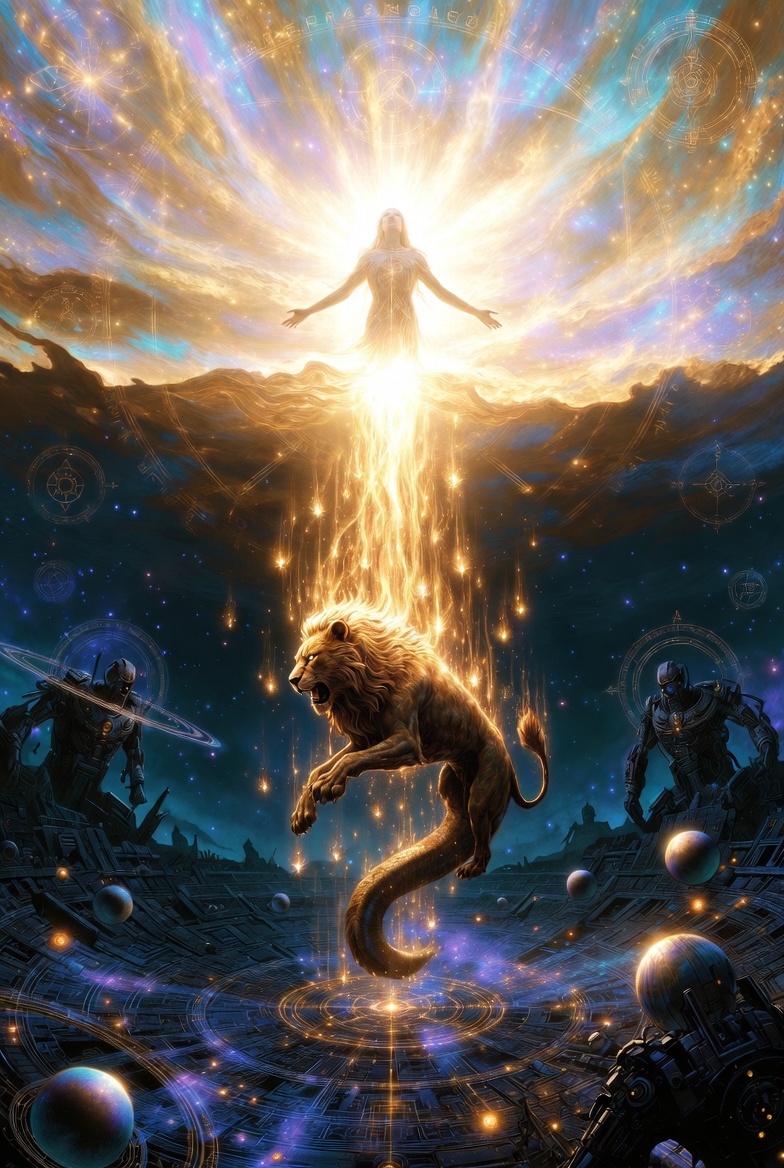
In the divine realm, creation normally happens in balanced pairs with permission. Her solo act produces something imperfect: Yaldabaoth (also called the Demiurge, meaning "craftsman" or "maker"). He's described as malformed — often with a lion's head and serpent body — arrogant, ignorant, and unaware of the higher Pleroma. He's not purely evil at first, but flawed and power-hungry.
Sophia is horrified by her "abortion" or monstrous child. She tries to hide him away from the Pleroma. This expulsion casts Yaldabaoth into the chaotic void outside the divine Fullness.
4. The Birth of the Material World and the Archons
Yaldabaoth, believing himself to be the only god (he's ignorant of higher realities), uses the leftover divine power he inherited from Sophia to create the material universe — our physical cosmos. He makes the stars, planets, laws of nature, and so on. He also creates Archons (rulers or authorities) — his offspring/servitors, often 7 or 12 in number, who help him govern this new realm like cosmic bureaucrats or planetary overseers.
Gnostics saw this material world as a kind of flawed copy or simulation of the true spiritual reality. It's mechanical, illusory, and trapping — built through imitation rather than true creative power. The Archons act as counterfeit spirits that enforce ignorance, fate, and control, keeping divine sparks (bits of light from the Pleroma) imprisoned in matter. Yaldabaoth is often identified with the Old Testament creator God, portrayed as jealous and demanding worship ("I am a jealous God, and there is no other").
5. Sophia's Repentance and Redemptive Role
Sophia realizes her mistake and repents. The higher Pleroma (Monad and other Aeons) hears her and offers help. She is partially restored or elevated but remains connected to the lower realms out of compassion. She becomes a mediatrix (go-between) — suffering with the trapped divine light and working to redeem it.
In the myth, divine agents (including Sophia) trick Yaldabaoth into infusing the first human (Adam) with spiritual light/power. This places divine sparks inside humanity. The goal of existence then becomes Gnosis (direct spiritual knowledge/insight): awakening that inner spark, seeing through the Archons' deceptions, and returning to the Pleroma. Sophia symbolizes the divine wisdom that calls us home.
Literal vs. Psychological Interpretations
- Literal/Exoteric: Some view the Archons as real interdimensional beings or forces that built and maintain our reality as a prison, deceiving souls (ancient "ancient aliens" or matrix-like ideas).
- Psychological/Inner: More common today — Sophia is your inner divine spark or intuition. The Demiurge/Archons represent ego, fear, societal conditioning, addictions, or unconscious patterns that create a "false self" and trap us in materialism. The "fall" is the soul's descent into ignorance, and Gnosis is enlightenment/liberation.
This myth flips the standard Genesis story: the "fall" happens in the divine realm before humans, the material world is inherently problematic (not a good creation corrupted later), and salvation comes through secret knowledge rather than faith or obedience alone. Gnostic texts like the Apocryphon of John (Secret Book of John) are key sources for this narrative.
Sophia is both the cause of the "problem" (through her error) and a key to the solution (through her wisdom and repentance). She's a tragic, compassionate figure — like a divine mother whose mistake birthed our complicated reality but who now guides us out of it. Different Gnostic groups had variations, but this core story is widespread.
The Archons are the cosmic "middle managers" or enforcers in this Gnostic myth — a hierarchy of flawed, often malevolent (or at least ignorant and oppressive) beings who serve Yaldabaoth (the Demiurge) and rule over the material universe. They are not ultimate evil in the way Satan is in some traditions, but they are counterfeit, imitative powers that lack true divine spark (ennoia). They build and maintain a mechanical, illusory cosmos that traps souls.
Their Origin Story
It all traces back to Sophia’s mistake:
Sophia creates Yaldabaoth alone → imperfect being with some stolen divine light but mostly darkness/ignorance.
Yaldabaoth is cast out and, in his isolation and arrogance, starts creating. He generates the Archons as his children or emanations — often by speaking them into being or through further imperfect reproduction. In texts like the Apocryphon of John, they emerge from him as a retinue of powers.
They inherit his flaws: They are blind to the higher Pleroma (the true spiritual realm), they think Yaldabaoth is the supreme god, and they are filled with pride and a desire to dominate. Some descriptions call them "androgynous" with beast-like faces (lion, serpent, etc.), reflecting their hybrid, unnatural nature.
Structure and Numbers
- The Hebdomad (Seven Archons): The primary rulers, each linked to one of the seven classical planets (Moon, Mercury, Venus, Sun, Mars, Jupiter, Saturn). They control the "spheres" or heavens that souls must pass through. These are the most important "planetary rulers."
- Twelve Archons: Sometimes associated with the zodiac signs or additional authorities. They help govern the broader cosmic order.
- Lower powers/angels: The Archons create further subordinate beings (hundreds, even 365 in some counts — one for each day), forming a vast bureaucratic hierarchy of cosmic control.
Yaldabaoth is the chief (the "Great Archon"), and the others are his offspring/servitors.
What Do the Archons Actually Do?
They are imitators (using phantasia or illusion/mimicry rather than true creative wisdom). They copy elements from the higher spiritual realm but produce only a flawed, dead, clockwork version:
- Creators of the material world: They shape the physical cosmos, including stars, planets, elements, and natural laws. This world is seen as a prison or simulation — beautiful in a deceptive way but ultimately entropic and limiting.
- Creators of the human body and psyche: In the myth, the Archons (under Yaldabaoth) mold the physical Adam from matter. They also create the soul/psychic aspects (emotions, desires, intellect) that bind the divine spark. They design the body as a trap for the spirit.
- Enforcers of fate and control: They govern destiny, time, reincarnation cycles, and the "laws" of the world. They use astrology, religions, governments, and material pleasures/fears to keep souls distracted and ignorant of their divine origin.
- Soul blockers: After death, souls try to ascend back to the Pleroma. The Archons guard the planetary spheres like cosmic toll booths or jailers. Without Gnosis (the secret knowledge/passwords or insight), souls get recycled back into matter. They deceive souls with false lights or promises.
- Counterfeit spirits: They implant thoughts, emotions, or religious ideas that promote materialism, division, blind faith, or worship of the Demiurge (e.g., the jealous Old Testament God in some interpretations).
They rely on mimicry because they lack the true creative spark. Their cosmos is inorganic/mechanical — a pale imitation of the living divine Fullness.
Key Themes and Interpretations
- Literal view: Real interdimensional entities or alien-like rulers who engineered Earth as a farm for souls or energy. Some modern readings link them to UFO phenomena, government control, or hyper-dimensional forces.
- Psychological/metaphorical: Internal forces — the ego, societal programming, addictive patterns, fear-based thinking, or the "system" that keeps people asleep. The Archons represent anything that enforces illusion and prevents awakening.
They are ignorant, not all-powerful: Many texts stress that the Archons (and Yaldabaoth) are ultimately powerless against true Gnosis. Higher powers (Sophia, Christ/Autogenes, etc.) can bypass or trick them, as when they help infuse divine light into humanity.
In the bigger picture, the Archons exist because of Sophia’s error, but they also serve a kind of cosmic purpose in the drama of fall and redemption. The divine plan involves using this flawed system as a school or arena for souls to awaken.
This layer adds the "who’s running the show down here" element to the myth. The material world isn’t neutral or good — it’s administered by these ignorant rulers who want to keep the divine sparks (us) from returning home.
Gnosis
Gnosis (Greek for "knowledge") is the central key in Gnosticism. It is not ordinary intellectual knowledge, book learning, or even faith/belief. It is direct, experiential, transformative spiritual insight — an inner awakening or "remembering" of your true divine origin. It reveals the illusion of the material world and the Archons' control, allowing the divine spark (pneuma or spirit) within you to recognize itself as belonging to the higher Pleroma, not the Demiurge's realm.
Gnosis defeats the Archons because they rule through ignorance (agnoia). Once you see through their deceptions — realizing Yaldabaoth is not the true God, the world is a flawed copy, and your core self is a fragment of divine light — their power over you dissolves.
It's like waking up inside the matrix: the rules still exist, but you are no longer bound by them in the same way.
What Exactly Does Gnosis Reveal?
- You are not fundamentally a body or even a soul (psyche), but a spirit (pneuma) — a spark of the higher divine realm trapped in matter.
- The Archons and Demiurge are ignorant pretenders, not ultimate authorities.
- Salvation comes from within, through knowledge of self/God, not external rituals, sacrifices, or blind obedience.
- The material world is a temporary prison or training ground, not your true home.
This knowledge is often described as liberating joy, peace, or a sudden "aha" that shifts your entire being.
How Do You Access Gnosis?
Gnostic texts emphasize it is not earned by effort alone but granted through grace, readiness, and seeking. Common paths and methods include:
- Inner Turning / Introspection: Quiet the noise of the body, emotions, and intellect. Practices like meditation, contemplation, or "stripping away" layers of illusion (similar to some mystical traditions) help reveal the spark within.
- Revealed Teachings / Myth: Studying Gnostic scriptures (e.g., Apocryphon of John, Gospel of Thomas, Hypostasis of the Archons) provides the map. The myths are not literal history but symbolic keys to awaken remembrance.
- The Role of a Savior Figure: Many Gnostic systems feature a divine emissary — often Christ (as Autogenes or the Logos) or other light-beings — who descends to impart Gnosis. This can be an external teacher or an inner revelation. Sophia herself acts as a guiding wisdom.
- Baptism of Knowledge: Some groups had rituals, but true Gnosis transcends them. It might involve sacred formulas, invocations, or passwords.
- Asceticism and Ethics: Detachment from material pleasures/fears weakens the Archons' hold. Ethical living (avoiding harm, excess) helps purify the soul, but Gnosis itself is the liberator — not moralism for its own sake.
- Direct Experience: Visions, ecstatic states, or sudden insight during crisis/prayer. It is personal and often ineffable (hard to put into words).
Accessing it is gradual for most — a process of awakening rather than a one-time event. Modern interpreters link it to mindfulness, Jungian psychology (integrating the unconscious), or non-dual awareness practices.
How Do Souls Escape the Archons and the Material "Contraption"?
After death (or through advanced Gnosis while alive), the soul begins an ascent through the cosmic spheres ruled by the Archons. This is the "post-mortem journey" described in texts:
The unprepared soul is deceived or overpowered and recycled back into reincarnation (metempsychosis) under the Archons' fate.
The Gnostic soul, armed with knowledge, passes the Archons by:
- Knowing their names and true nature → This disempowers them (like passwords or exposing a bluff).
- Reciting formulas or hymns of light → Some texts give specific invocations that declare your higher origin ("I am a child of the Father," etc.).
- Shining with inner light → The divine spark repels the darkness/Archonic forces.
Beyond the seven planetary spheres (the Hebdomad) lies the Ogdoad (eighth sphere) or higher realms, leading back to the Pleroma. There, the soul reunites with the divine Fullness, often rejoining Sophia or the higher powers in bliss.
In life, "escaping" means living in the world but not of it — achieving inner freedom while the body remains. Some advanced Gnostics were said to transcend physical death consciously.
Important Notes
- Not all Gnostic groups agreed on every detail — some were more ascetic, others more libertine (using the body to transcend it).
- This is radically different from mainstream Christianity (which emphasizes faith, grace through Christ, and resurrection of the body) or other religions.
- Modern revivals (e.g., in esoteric, psychedelic, or philosophical circles) adapt it: Gnosis as psychological integration or awakening from consensus reality.
Gnosis is ultimately self-authenticating — you know when you have it because it transforms you. The myths and practices are tools to point you inward toward that recognition.
The Map from Key Gnostic Scriptures
Here’s a practical overview drawn from the texts mentioned. These are symbolic "maps" for awakening and ascent, not rigid step-by-step instructions. Gnosis itself is the living key — the texts point the way.
- Apocryphon of John (Secret Book of John) — The Core Cosmological Map. This is the most detailed text for the overall structure: The Fall and Trap: Sophia’s error → Yaldabaoth + Archons create the flawed cosmos and trap divine light in humanity. The Rescue Plan: Higher powers (including the luminous Epinoia, a form of Sophia/insight) implant or awaken the divine spark. Christ (as the revealer) descends in various forms to teach Gnosis. Salvation: Realizing your spiritual identity as part of the "immovable race" or seed of Seth (the perfected spiritual humanity). Reject the counterfeit world and return to the Pleroma through knowledge. It describes reincarnation for those without Gnosis and ascent for those who awaken. It doesn’t give a long list of specific post-death passwords in the most common versions, but stresses knowing the true hierarchy and declaring your origin from the higher light.
- Hypostasis of the Archons (The Reality of the Rulers): This text focuses on the Archons’ arrogance and blindness. Key themes: The Archons try to create and control humanity but fail to contain the spirit. It includes a strong feminist/empowering take on Eve and the spiritual woman who awakens insight. Salvation comes from recognizing the Archons’ counterfeit nature and turning toward the true Father (the Invisible Spirit). It emphasizes resistance to the rulers through inner truth.
- Gospel of Thomas — The Inner Gnosis Map: This is a collection of 114 sayings of Jesus (many overlapping with canonical Gospels but more esoteric). It is less about cosmology and more about direct realization: Saying 3: "The kingdom is inside of you, and it is outside of you. When you come to know yourselves, then you will become known..." Saying 70: "Jesus said, 'That which you have within you will save you if you bring it forth from yourselves.'" Saying 111: Focus on transcending death by finding the one who is not born and does not die. Overall message: Gnosis is self-knowledge that reveals the divine light within. No need for external authorities or temples — the Kingdom (Pleroma) is at hand when you awaken. It’s a practical manual: seek, question, turn inward, detach from the world’s illusions.
Specific Invocations / Passwords / Formulas for Passing the Archons
Ancient Gnostic texts (especially ascent traditions in the broader literature, like parts of Pistis Sophia or related Sethian works) describe the soul needing names, declarations, or formulas when confronting the planetary Archons after death. These are not magic words in a Harry Potter sense — they embody Gnosis: declaring your true identity, origin, and detachment from the Archon’s domain. Knowing them shows you are awake and not under their authority.
Examples drawn from Gnostic and related traditions (reconstructed/adapted from sources; exact wording varies by text/translation):
- General Declaration of Origin: "I am a child of the Father, the One who is from the beginning. I come from the light and return to the light. You have no power over me."
- To an Archon (common motif): "I am you and you are I." (Recognizing the shared divine spark even in the ignorant ruler, while transcending their claim.) Or: "I have passed through [element/fire/etc.] and was not burned/consumed." (Showing mastery over the Archon’s domain.)
- For Specific Spheres (modern syntheses based on planetary associations; one example set): Moon/Saturn-level (limitation, time): "I am" (pure existence beyond form). Other rulers: Declarations like "I seek not what you offer, for I possess what you cannot give" or affirming origin from the higher realms.
- Stronger Ascent Formula (echoed in some Gnostic-inspired accounts): "I am a stranger to this world. My race is from above, from the luminous realms. Let me pass, for I know the secrets and bear the light."
The power lies in embodied understanding, not rote recitation. The Archons are defeated by insight that dissolves their illusory hold — you declare truth with the authority of Gnosis.
In practice: While alive: Use meditation/contemplation on these ideas. Affirm your divine spark daily. Study the myths as mirrors for inner states. The ultimate "invocation" is the inner call to the higher powers (Sophia, Christ, the Invisible Spirit) for revelation.
These texts form a map of remembrance: Know the true God → Know the counterfeit creators → Know yourself as divine spark → Awaken and return. The journey is both cosmological (after death) and psychological (now).
Gnosis traditions warn against dogmatism — the map is not the territory. The real access is inner transformation.
The Apocryphon of John (Secret Book of John)
The Apocryphon of John (Secret Book of John) is not written by the same "John" as the canonical Gospel of John, 1–3 John, or Revelation in the Bible. This is a key point of confusion. They are different texts from different early Christian communities with very different worldviews. Here's a clear breakdown of how and why they differ so sharply.
1. Different Authors, Times, and Communities
Canonical Bible John texts (Gospel of John, Letters, Revelation): Likely written late 1st to early 2nd century CE. Attributed traditionally to John the Apostle or his community. They became part of the orthodox (mainstream) Christian canon by the 4th century. They emphasize faith in Jesus as the incarnate Son of God, salvation through his death and resurrection, love, and obedience to God's commandments.
Apocryphon of John: A 2nd-century Gnostic text (Sethian branch). It claims to be a secret post-resurrection revelation from Jesus to the apostle John. It was not included in the Bible — early church leaders like Irenaeus (c. 180 CE) actively opposed and criticized Gnostic teachings as heresy. It was rediscovered in the 20th century among the Nag Hammadi library (Egypt, 1945).
These are parallel but rival interpretations of Jesus' teachings circulating in the same era. The early Christian movement was diverse; the version that became "orthodox" eventually won out.
2. Core Theological Differences
Here’s the same information rewritten in flowing paragraphs for easier reading:
The Apocryphon of John presents a radically different cosmology, view of God, and path to salvation compared to the canonical Bible (especially Genesis and the Gospel of John).
In the canonical Bible, there is one supreme Creator God (Yahweh) who directly creates the world and declares it good. The fall into suffering and separation happens because of human sin in the Garden of Eden (Adam and Eve’s disobedience). The material world is basically good but has been corrupted by that original fall. Humanity is created in God’s image as a unity of body and soul. Jesus is the incarnate Word and Son of God who dies for humanity’s sins and rises again. Salvation comes through faith in Christ, repentance, and God’s grace, with the hope of bodily resurrection and the eventual renewal of creation. The God of the Old Testament is the true and only God.
By contrast, the Apocryphon of John describes an unknowable supreme Monad or Invisible Spirit far above our world. The biblical creator God is often reinterpreted as the ignorant and arrogant Demiurge (Yaldabaoth), born from Sophia’s unauthorized act of creation. This Demiurge, along with his Archons, fashions a flawed, prison-like material world as an imitation of the true spiritual realm. The fall originates not primarily from human sin but from a cosmic error higher up (Sophia’s unilateral creation). Humanity’s physical body and lower soul are made by the Archons, while the true self is a divine spark trapped inside. Jesus functions mainly as a revealer who brings secret Gnosis to awaken that spark (sometimes appearing in non-physical or multiple forms). Salvation is achieved through direct knowledge and inner awakening (Gnosis), which allows the spirit to escape the material trap and the Archons, returning to the Pleroma (divine Fullness). This process may involve multiple lives until full realization occurs, and the Old Testament God is viewed as the arrogant Demiurge speaking out of ignorance when he claims to be the only god.
This side-by-side shows why the two feel so different: they offer competing explanations for the same deep human questions about God, evil, and liberation.
The Apocryphon reinterprets the Bible allegorically or critically. It treats Genesis as a distorted story needing correction through secret teachings. For example, the serpent in Eden is sometimes seen positively (as a bringer of knowledge), and the creator God is demoted.
3. Why the Heavy Differences?
- Philosophical Influences: Gnosticism blended Christianity with Platonism (idea of a perfect spiritual realm vs. imperfect material copy), Jewish mysticism, and other ideas. Orthodox Christianity emphasized Jewish scriptures + literal-ish history + accessible faith for all.
- Different Answers to "Why is the world evil/suffering?": The Bible attributes it to human sin (fall in Garden). Gnostics asked: If the world is so broken and the creator God seems jealous/cruel in the OT, maybe he's not the true highest God. This solves the "problem of evil" by distancing the ultimate divine from the messy material world.
- Elite vs. Accessible Knowledge: Orthodox Christianity developed a public creed and hierarchy. Gnostics often emphasized secret, inner knowledge (Gnosis) for the spiritually mature ("pneumatics" or spiritual people).
- Historical Conflict: By the late 2nd–4th centuries, church fathers fought Gnostic groups. They standardized the New Testament canon partly to exclude texts like the Apocryphon. Reasons included: too negative about the material world, rejection of bodily resurrection in favor of spiritual ascent, and claims of "secret teachings" beyond the public Gospels.
4. "John" as a Common Name
Multiple early Christian figures/groups used the name "John." The canonical Gospel focuses on signs, belief ("that you may believe"), and eternal life through Jesus. The Apocryphon uses the same apostolic authority to claim a deeper, hidden layer — Jesus privately telling John the "real" backstory after the resurrection. It's a common ancient technique: attribute your teachings to a respected figure for legitimacy.
In short: The Bible (canonical texts) presents one major stream of early Christianity that became dominant. The Apocryphon of John represents a different, ultimately rejected stream that offered a more pessimistic view of the world and an esoteric path of inner knowledge. They feel "completely different" because they are competing visions from the same formative period of Christianity.
Many people today read both for historical insight or personal spirituality, seeing them as complementary perspectives rather than strict contradictions. The canonical Bible won in terms of institutional religion, while Gnostic ideas influenced mysticism, philosophy, and modern esotericism.
I understand the tension you're feeling. The world does often seem like a confusing, deceptive, or controlling place — full of suffering, hidden influences, cycles of desire and fear that keep people trapped in unfulfilling patterns. Both biblical and Gnostic traditions address this, but in ways that can feel like puzzle pieces from the same larger mystery. Many people across history have sensed this: a sense of being "asleep" or farmed by systems (materialism, power structures, inner compulsions). Let's break it down honestly and constructively.
Reconciling the Two "Creation Stories"
Early Christianity was not monolithic — there were diverse interpretations before a more unified "orthodox" version solidified. The Bible (especially Genesis) gives a surface-level story: one God creates a good world → human disobedience introduces brokenness → need for redemption. Gnostic texts like the Apocryphon of John offer a "behind-the-scenes" myth: a perfect spiritual realm → Sophia's error → ignorant Demiurge + Archons build a flawed copy where divine sparks are trapped.
Similarities: Both involve a creator figure(s), a fall/error, deception, and the need for liberation or return to a higher state. "Reptilian" imagery appears in both: Bible has the serpent in Eden (cunning deceiver); Gnostic Archons are often serpent/lion-like. This archetype evokes cold, predatory, controlling forces (whether literal entities or symbolic of ego, institutions, or adversarial powers). Both warn of rulers/principalities (Ephesians 6:12 in the Bible: "spiritual forces of evil in the heavenly realms") and urge discernment.
Differences: Bible: The creator is ultimately good (though mysterious); salvation is through relationship, faith, and a future renewal of creation. The material world is real and will be redeemed. Gnostic: The visible creator/rulers are flawed/ignorant; salvation is escape via inner knowledge (Gnosis). The world is more like a simulation or prison.
A Christian (or anyone) can "wrap their mind around" this by viewing them as:
Metaphorical layers: The Bible for ethical living and hope in the world; Gnostic myths for deep psychology — explaining why we feel alienated or controlled.
Historical diversity: Early followers of Jesus debated these ideas. The winning version became the Bible; suppressed ones survived in Gnostic writings. Both pointing to truth: Half-truths or progressive revelation. The Bible might simplify for accessibility ("don't eat the fruit" = don't fall for deception), while Gnostic texts explore the "why" behind the illusion. Many modern Christians (mystics, contemplatives) integrate both without contradiction by treating Gnostic elements symbolically.
The "farmed/harvested/controlled" feeling aligns with themes in both: biblical "powers and principalities," Gnostic Archons, or even Jesus' warnings about "the ruler of this world."
Whether literal interdimensional beings, psychological archetypes, or societal mechanisms (media, economics, biology), the effect is similar: distraction from your deeper nature.
Wanting "Off This Ride" — Paths to Transcendence
This desire is ancient and universal. You don't need perfect doctrinal resolution to begin waking up. Here's a grounded approach drawing from both traditions:
- Cultivate Discernment and Inner Knowing (Gnosis-like): Question everything: Whose voice is this — fear, desire, society, or something deeper? Practices: Daily silence/meditation (even 10–20 minutes). Observe thoughts without attachment. Ask: "Who am I beyond this body/mind/story?" Biblical parallel: "Be transformed by the renewing of your mind" (Romans 12:2). Gnostic: Know yourself as the divine spark.
- Detach from the "Farm" Mechanisms: Reduce consumption of fear-based media, endless scrolling, addictive loops. Simplify life: Less identification with status, possessions, or tribal conflicts. Ethical living: Compassion and truthfulness weaken "Archonic" control (whether inner or outer).
- Invoke Higher Awareness: Prayer/affirmation drawing from both: "I am not of this world" (Jesus in John 17) + declarations of origin from the Light. Call on wisdom (Sophia/Holy Spirit) for guidance. Many find Christ as the bridge — revealer who overcomes the rulers.
- Community and Study: Read primary sources yourself (Nag Hammadi translations are available online). Explore Christian mystics (e.g., Meister Eckhart, Julian of Norwich) who sound somewhat Gnostic — inner divine union. Balanced voices: Avoid extreme conspiracy rabbit holes that increase paranoia; seek those fostering peace and agency.
Transcendence isn't necessarily leaving the body instantly — it's living awake within the world. Many traditions describe it as dying to the false self and rising in awareness. The ride feels less oppressive when you're no longer fully identified with it.
Practical Next Steps
- Start small: Journal what "deception" looks like in your daily life and one way to step back from it.
- Body-mind practices: Breathwork, nature time, or contemplative prayer to feel the "spark" beyond thoughts.
- If the weight feels heavy (existential distress), talk to a trusted counselor or spiritual director — this territory can be destabilizing.
You're not alone in wanting truth and freedom. Both the Bible and Gnostic stories ultimately point toward hope: the light within is stronger than the rulers, and awakening is possible. The full story may be bigger than either tells alone. Keep seeking with an open, discerning heart — that's the real path off this ride.