

The Eternal Echo: Decoding Ancient Wisdom in the Emerald Tablets, Sumerian Tablets, and Nag Hammadi Codices
Posted in: Ancient Mysteries · Esoteric Wisdom · Comparative Mythology
Date: 2026-5-11 18:43:17
DISCLAIMER: This article offers a comparative retelling of ancient mythological, esoteric, and spiritual narratives from the Emerald Tablets, Sumerian tablets, and Nag Hammadi texts. It is for informational and exploratory purposes only. These accounts are presented as traditional stories and should not be interpreted as verified historical or scientific fact. Reader discretion advised
The Eternal Echo: A Shared Ancient Story
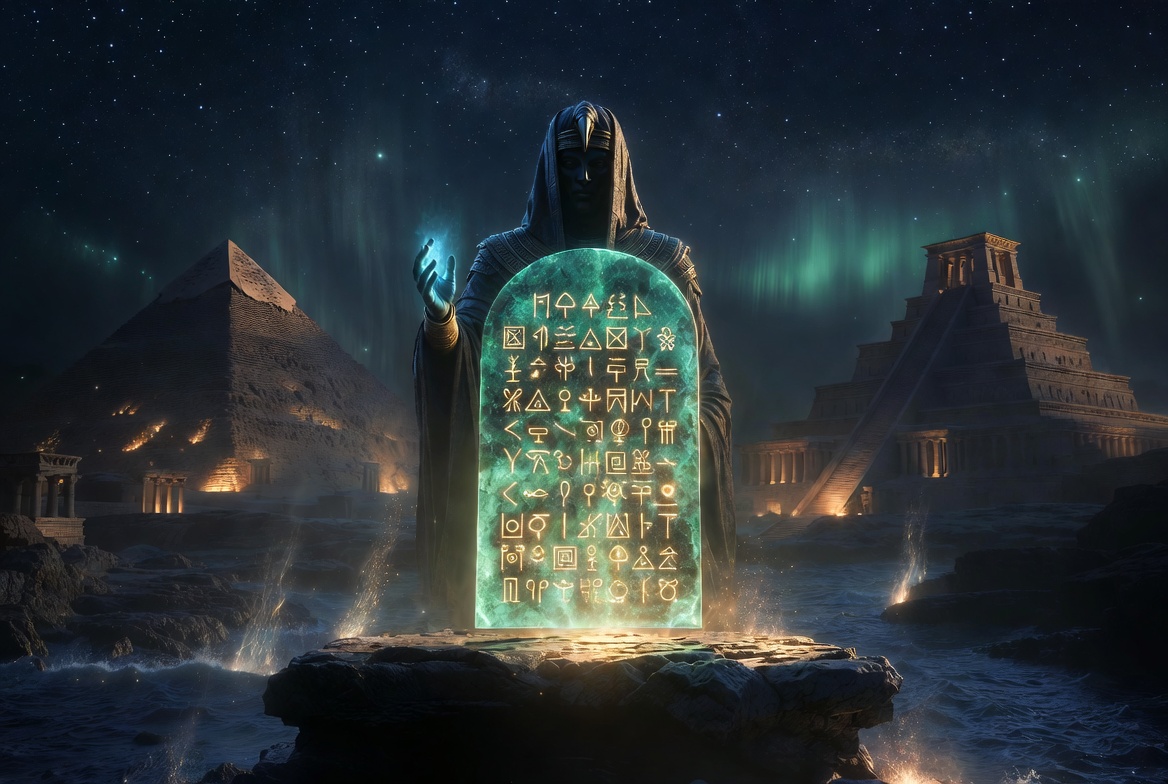
Across millennia and continents, certain sacred writings have preserved what many see as fragments of a single, profound human story—one of divine intervention in our origins, cataclysmic resets, hidden knowledge, and the spark of something greater within us. The Emerald Tablets attributed to Thoth the Atlantean, the ancient Sumerian cuneiform tablets of Mesopotamia, and the Gnostic scriptures of the Nag Hammadi library each unfold this tale in their own cultural voice. Far from isolated myths, they appear to retell the same core narrative: higher beings shape humanity, conflict arises among the powers that rule, a great destruction nearly wipes the slate clean, and secret wisdom is offered to those ready to awaken and rise beyond the material world.
The Emerald Tablets of Thoth: Wisdom from a Lost World
The Emerald Tablets recount the autobiography and teachings of Thoth, an immortal Atlantean priest-king also known as Hermes Trismegistus in later traditions. According to the text, Thoth lived for over 16,000 years in a highly advanced civilization called Atlantis, where people mastered cosmic energies, interdimensional travel, and the fundamental laws of reality. Atlantis flourished through spiritual and technological harmony until its people misused these powers, triggering a cataclysm that caused the continent to sink beneath the waves.
Before the final destruction, Thoth received a command from the Dweller of Unal (a great being of light) to gather the records of Atlantis, along with the “sons of Atlantis”—survivors of the wise and enlightened. They journeyed (some accounts describe this as travel by advanced craft) to the land of Khem, ancient Egypt. There, Thoth and his followers established a colony among a more primitive people. He ruled as a benevolent king and master of mysteries for millennia, civilizing the region, building the Great Pyramid and Sphinx as temples of wisdom and repositories of knowledge, and eventually becoming deified as the god of writing, magic, and records.
Inscribed on imperishable emerald tablets (fifteen chapters in the revealed version), Thoth’s teachings form the foundation of Hermetic philosophy. They detail the Seven Hermetic Principles that govern the universe—mentalism, correspondence, vibration, polarity, rhythm, cause and effect, and gender. Thoth describes the Halls of Amenti, an underground realm where souls journey for judgment, purification, and eventual reincarnation or ascension. He reveals keys to magic, freedom of space and time, prophecy, and the path to immortality: by raising one’s vibration through wisdom and alignment with cosmic law, humans can transcend death, enter higher planes, and reunite with the divine source. The tablets end with a message for future generations—those who prove worthy will one day access the hidden records and awaken the dormant power within.
The Sumerian Tablets: The Gods Who Engineered Humanity
The clay tablets of ancient Sumer (and later Babylonian and Assyrian versions) preserve some of the oldest written accounts of creation, preserved in cuneiform script from roughly 4,000 years ago. Central among them are texts like the Eridu Genesis, the Atrahasis epic, and the Enuma Elish (the Babylonian Epic of Creation).
In these stories, the Anunnaki—great gods who descended from the heavens—arrive on Earth and establish order. Tired of the labor required to maintain the world, the gods (led by figures like Anu, Enlil, and Enki) decide to create servants. Enki, the wise and compassionate god of wisdom, magic, and the waters, collaborates with the mother goddess Ninhursag (or Nintu). Together they fashion the first humans by mixing clay with the blood or essence of a sacrificed god, infusing humanity with divine intelligence and life force. Humans are created to till the soil, mine resources, and relieve the gods of toil.
Humanity multiplies rapidly and becomes noisy, disturbing the peace of Enlil, the powerful god of storms and authority. Irritated, Enlil sends plagues and, ultimately, a devastating flood to wipe out mankind. Enki, however, defies the council of the gods and secretly warns a pious human leader—Ziusudra (or Atrahasis/Utnapishtim in later versions)—instructing him to build a massive boat, load it with his family, animals, and the seeds of life, and ride out the deluge. After seven days and nights of raging waters, the flood recedes. The survivor offers sacrifices, the gods regret their haste, and Enlil grants Ziusudra immortality as a reward for his obedience and piety. In the Enuma Elish, a parallel cosmic battle sees the younger god Marduk defeat the chaotic primordial goddess Tiamat, using her body to fashion the heavens and earth, and creating humans from the blood of a defeated divine rebel to serve the gods.
These tablets portray humanity as a deliberate creation of the Anunnaki, gifted with a portion of divine essence yet bound to serve—until wisdom and survival allow a chosen few to transcend ordinary limits.
The Nag Hammadi Codices: The Secret Book of Divine Spark
Discovered in 1945 near Nag Hammadi in Egypt, these fourth-century Coptic manuscripts contain a library of Gnostic texts, including the Apocryphon of John (Secret Book of John), which offers one of the most detailed Gnostic creation myths. Revealed by the risen Christ to his disciple John, the story describes a perfect, invisible Spirit—the true God or Monad—beyond all form. From this source emanates a divine hierarchy of aeons (eternal beings) in the luminous realm of the Pleroma (Fullness), including Barbelo (the first thought) and, ultimately, Sophia (Wisdom), the youngest aeon.
Driven by a desire to create something of her own, Sophia acts alone, without her consort or the approval of the Monad. Her thought manifests as Yaldabaoth (also called the Demiurge or “child of chaos”), a flawed, lion-headed, serpent-bodied being of immense but incomplete power. Horrified, Sophia casts him out of the divine realm. Yaldabaoth, ignorant of his higher origins and declaring “I am God and there is no other,” establishes his own lower realms and creates a host of archons (rulers) to govern them. Imitating the divine pattern he dimly perceives, he fashions the material world and its heavens.
Yaldabaoth and the archons then create Adam in the image of the perfect divine human they glimpse above. Yet Sophia secretly infuses humanity with a spark of the true divine light from the Pleroma. The archons, sensing this light, attempt to trap it within physical bodies and keep humanity ignorant and enslaved through illusion and law. The true God responds by sending messengers—including Christ as the ultimate Savior—to impart gnosis (direct, secret knowledge). This gnosis awakens the divine spark within, allowing the soul to transcend the material prison, defeat the archons, and return to the Pleroma.
The Nag Hammadi texts emphasize that salvation comes not through blind faith or ritual but through inner knowledge, revealing that the material world is a flawed copy ruled by an arrogant lesser creator, while the true divine essence waits to be remembered and liberated.
The Shared Story: One Tale, Many Voices
Though separated by thousands of years and distinct cultures—Atlantis to Egypt, Mesopotamia’s river valleys, and early Christian Egypt—these three collections echo the same fundamental narrative. Higher beings (Anunnaki, Atlantean masters, or emanations from the Monad) intervene in human origins, blending divine essence with earthly matter to create us as workers, images, or vessels. A hierarchy of powers emerges: benevolent teachers (Enki, Thoth, Sophia, and the Savior) who offer wisdom, contrasted with authoritative rulers (Enlil, Yaldabaoth, and the archons) who seek control or destruction when humanity grows too numerous or aware.
Cataclysm follows—Atlantis sinks, the great flood engulfs the world, or the material realm itself becomes a realm of limitation—yet survivors are preserved through secret guidance. Most powerfully, each text insists that humanity carries a divine spark, hidden knowledge, or inner potential for immortality and ascension. Thoth’s tablets provide keys to vibrational mastery and the Halls of Amenti; Sumerian accounts grant immortality to the flood survivor through divine favor; Gnostic revelation offers gnosis to escape the archons and return to the Pleroma.
In each telling, the story repeats: we are not accidental, but intentionally formed by greater forces. A portion of the divine lives within us. Catastrophe tests us. And the path forward lies in awakening—through wisdom, alignment with cosmic law, or secret knowledge—to claim our heritage as beings of light.
These ancient records invite us to listen to the same story as it echoes across time, reminding every generation that the keys to our origins, our trials, and our ultimate freedom have always been preserved for those with eyes to see and hearts to understand. Whether inscribed on emerald stone, pressed into Mesopotamian clay, or copied onto papyrus in hidden jars, the message remains: the story is not over, and the wisdom is waiting.